


Stingy Scientist
1997 Honorable Mention
Confirmed True by Darwin
Confirmed True by Darwin
Guest Writer: Fred Walker
(1966, Australia) Against animal testing?
How about human animal testing?
 Dr. Jack Barnes, of Cairns, Australia, failed to halt the spread of his own
mad scientist genes, but his survival wasn't due to a lack of effort on his
part. In 1966, Barnes was hot on the heels of the source of a mysterious
illness called Irukandji Syndrome. Sufferers endure excruciating back
pain, sweating, and nausea. He suspected that the source of the illness was
a tiny marine creature, so he set about finding it by sitting on the
seabed for hours, wearing a weighted diving suit.
Dr. Jack Barnes, of Cairns, Australia, failed to halt the spread of his own
mad scientist genes, but his survival wasn't due to a lack of effort on his
part. In 1966, Barnes was hot on the heels of the source of a mysterious
illness called Irukandji Syndrome. Sufferers endure excruciating back
pain, sweating, and nausea. He suspected that the source of the illness was
a tiny marine creature, so he set about finding it by sitting on the
seabed for hours, wearing a weighted diving suit.
Note the outstanding Darwin potential demonstrated.
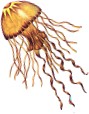
However, the Grim Reaper did not yet beckon. Instead, the fickle finger of fate rewarded him by revealing the source of the mystery illness: a minute jellyfish, its bell measuring only an inch across. It was at this point that the Doctor's latent Darwin potential, already hinted at, was unleashed to its full (and nearly fatal) potential.
There are many toxic jellyfish off the coast of Australia. Our dedicated scientist knew he must test his hypothesis that this gelatinous creature was toting the particular venom that causes Irukandji Syndrome. And how best to go about this?
He chose the most expedient method available: he stung himself.
Foolish? Yes, but the good Doctor was not done yet. To reach truly dizzying heights of Darwinian grandeur, one must ensure that one's deficient DNA is entirely removed from the gene pool. As Dr. Barnes had already sired an heir, there was only one thing left to do...
He stung his 14-year-old son as well!
Despite this truly outstanding effort to place the continued existence of the Barnes lineage in mortal peril -- alas, it wasn't to be. Dr. Barnes, his son, and the nearby lifeguard whom the good Doctor also introduced to the joys of Irukandji Syndrome, were all rushed to the Intensive Care Unit of a nearby hospital. All three survived.
As a final twist, not only will the mad scientist's genes live on, but so too will the family name: the jellyfish was named Carukia barnesi in the intrepid scientist's honour!
